Updated September 2026.
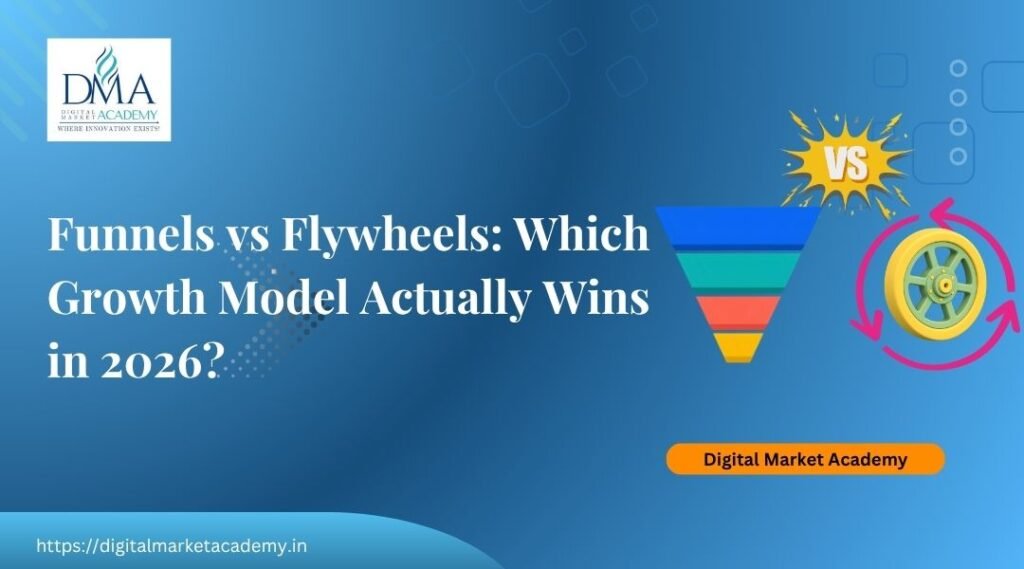
The funnel vs flywheel debate is really a debate about how you think growth works. For decades, marketers pictured growth as a funnel: pour strangers in the top, push them down through awareness and consideration, and collect customers at the bottom. It is a useful picture, but it hides a costly flaw. It treats the customer as the finish line, when in modern marketing the customer is where the real growth begins. The flywheel fixes that by making happy customers the engine that spins the whole thing faster. This guide explains both models in depth, shows where each fits, and uses real Indian examples so you can decide how to think about your own growth.
It is a companion to our guides on performance vs brand marketing, first-party data, and how to become a digital marketer. This is strategic thinking we teach throughout our course syllabus.
TL;DR
- A funnel is linear: strangers go in the top, customers come out the bottom, and the journey ends at the sale.
- A flywheel is a loop: happy customers feed growth through retention, referrals and reviews, so momentum compounds.
- Funnels still help you plan and measure a customer's first journey; they are not wrong, just incomplete.
- The flywheel fits 2026 because retention, first-party data, community and word of mouth now drive efficient growth.
- The best answer is not either-or: use a funnel to acquire, then feed those customers into a flywheel that keeps spinning.
What is a marketing funnel?
A marketing funnel is a linear model of the customer journey, from first awareness to final purchase. Picture a wide mouth at the top where many strangers enter, narrowing as people drop off at each stage, until a smaller number of customers emerge at the bottom. The classic stages are awareness, interest, consideration, and decision, sometimes summarised as the top, middle and bottom of the funnel.
The funnel became the default way marketers think for good reason. It is simple, it maps neatly onto how people discover and evaluate products, and it makes planning easy: you can assign a job to each stage, an awareness campaign here, a consideration email there, a conversion offer at the end. It also makes measurement tidy. You can count how many people enter each stage and calculate conversion rates between them, which is why so much of digital marketing reporting is still funnel-shaped. None of that is wrong. The funnel is a genuinely useful tool for understanding and improving how a stranger becomes a first-time customer.
What is a flywheel?
A flywheel is a circular model of growth in which happy customers become the force that drives more growth. Instead of a journey that ends at the sale, the flywheel is a loop: you attract strangers, engage and convert them, delight them as customers, and those delighted customers then attract and convince the next wave through referrals, reviews and repeat business. The wheel keeps spinning, and each satisfied customer adds momentum.
The idea borrows from physics. A heavy flywheel is hard to get moving, but once it is spinning, each push adds to the momentum already there, so it turns faster and faster with less effort. Applied to marketing, popularised in recent years by companies like HubSpot, the point is that your existing customers are stored energy. If you keep them happy, they do a large part of your marketing for you, and growth compounds rather than resetting to zero after every sale. Here is the shape of the difference:
The core difference: where does growth come from?
Strip away the shapes and the real difference is a belief about where growth comes from. Funnel thinking says growth comes from the top: to grow more, pour more strangers in. Flywheel thinking says growth comes from the middle: to grow more, keep more of the customers you already win and turn them into promoters. In a funnel, the customer is the output. In a flywheel, the customer is the input to the next turn.
This is not a small distinction. It changes what you measure, what you spend on, and what you consider success. A funnel-first team obsesses over cost per acquisition and top-of-funnel volume. A flywheel-first team cares just as much about retention rate, repeat purchase, referral rate and customer satisfaction, because those are the forces that make the next acquisition cheaper. When you internalise this, your whole approach to budgets and priorities shifts.
Why funnels dominated, and where they fall short
Funnels dominated because, for a long time, they matched reality. Media was expensive and one-directional, customers were harder to stay in touch with, and word of mouth was slow and hard to measure. In that world, the sensible strategy really was to focus on filling the top and converting the bottom. The funnel also survives because it is easy to teach, easy to report, and baked into most analytics tools.
But three cracks show when you rely on it alone. First, it ignores what happens after the sale, exactly the part that is now most profitable. Second, it treats every sale as a fresh start, so your growth resets to zero and depends on always buying more attention. Third, it quietly encourages short-term thinking: hit this month's leads, chase this quarter's conversions, and never mind whether those customers stay or leave. As acquisition costs climb, a business that only knows how to pour more into the top eventually gets squeezed, which is a pattern we explore in our D2C marketing guide, where over-reliance on paid ads is the classic trap.
Why the flywheel fits 2026
Several shifts have made the flywheel the more realistic model for how growth now works. Ad costs have risen, so acquiring every customer purely through paid media is increasingly expensive. Third-party cookies are fading, which raises the value of the first-party data you collect from your own customers. Social proof, reviews, and community now heavily influence what people buy, so a happy customer's voice carries real weight. And retention has always been cheaper than acquisition; it simply matters more now that acquisition is dearer.
Put together, these mean the customers you already have are your most valuable, most under-used marketing asset. A flywheel is simply the discipline of treating them that way: keeping them, delighting them, and giving them easy ways to bring you the next customer. It is not a trendy metaphor; it is a response to how the economics of marketing have changed.
Funnel vs flywheel: a side-by-side view
Seen next to each other, the two models make different assumptions at every level:
The honest answer: it is not either-or
Here is where a lot of the internet gets it wrong. The flywheel did not kill the funnel, and treating it as a rivalry misses the point. A funnel is still the clearest way to plan and measure how a stranger first becomes a customer, which is a real, necessary job. The flywheel describes what should happen next, and how that feeds back to make the funnel cheaper. The mature view is to use both: run an efficient acquisition funnel, then pour every customer it produces into a flywheel that keeps them and multiplies them.
In practice, the funnel becomes one arc of the wheel, the attract-and-convert arc, and retention, delight and referral complete the loop. Growth from the flywheel lowers your acquisition cost, because referrals and reputation feed the top of the funnel for free. The two models reinforce each other:
How Indian brands use flywheel thinking
You can see the flywheel at work across the Indian brands we have studied, even when they never use the word. CRED built rewards and referrals so members keep returning and bring others in. boAt turned buyers into boAtheads, a community that promotes the brand for free. Nykaa uses content and reviews so satisfied customers help convince the next shopper. Food delivery brands like Swiggy and Zomato lean on loyalty, habit and referrals to keep the same customers ordering again and again.
The pattern is consistent: these brands do not just acquire customers and move on. They build reasons for customers to stay, systems for customers to refer, and reputations that make the next sale easier. That is flywheel thinking in action, and it is a big part of why these brands grow efficiently rather than burning cash on endless acquisition.
And here is the desi truth about word of mouth: in India it rarely happens in textbook English. It is a friend in Chennai messaging macha, product semma, someone in Bengaluru saying guru, channagide, full paisa vasool, a cousin in Hyderabad going anna, chaala bagundi, a colleague in Kochi typing adipoli, must try, a buddy in Delhi saying bhai, ekdum mast hai. Every one of those tiny messages is your flywheel turning, one happy customer quietly pushing the next one in, in whatever language trust travels. No funnel report ever captures that, but it is often where the real growth is hiding.
How a Bangalore small business can apply this
You do not need a big brand's budget or some fancy funda to think in flywheels. Consider Meghana, who runs a small home-baking business in JP Nagar. In pure funnel mode, she would burn her limited budget on ads to find new customers every month, and start from zero each time, like a never-ending month-end target. Thinking in flywheels, she does something smarter: she delivers a genuinely delightful first order, adds a small handwritten thank-you and a WhatsApp opt-in, follows up with seasonal offers to past buyers, and gently asks happy customers to refer friends and leave a review. Soon her regulars are the ones messaging her akka, next batch yaavaga? (sister, when is the next batch?), and bringing their friends along.
Within months, a large share of her orders come from repeat customers and referrals, not ads. Her acquisition cost falls, because her existing customers are doing the marketing. She still runs a small funnel to attract new people, but the flywheel is what makes the business sustainable. This is the same logic the big brands use, scaled to a home kitchen, and it is available to any local business willing to treat existing customers as an engine rather than a finish line.
Force and friction: what speeds a flywheel and what slows it
A physical flywheel responds to two things: force applied to it, and friction resisting it. The marketing version works the same way, and this is the most practical lens for improving yours. Forces are anything that adds momentum: a genuinely delightful product experience, fast and helpful support, a simple referral reward, proactive follow-up, useful content that keeps customers engaged between purchases. Every one of these makes existing customers more likely to stay, buy again, and bring others.
Friction is anything that resists the spin: a confusing checkout, a slow reply to a complaint, a promise you did not keep, a loyalty programme nobody understands, a website that frustrates on mobile. Here is the important insight that funnel thinking tends to miss: removing a unit of friction often does more for growth than adding a unit of force. A single bad support experience can undo the goodwill of an excellent product, because an unhappy customer not only stops buying, they can spin the wheel backwards by warning others. So the discipline is twofold, deliberately add forces at the delight and referral stages, and hunt down friction everywhere, especially in the unglamorous operational moments after the sale where most businesses quietly lose people. When Aravind, who runs a small electronics store in Koramangala, mapped his own flywheel, he found his biggest brake was a slow, grudging returns process; fixing that one point of friction did more for repeat business than any new ad campaign.
The metrics that tell you a flywheel is working
You cannot improve what you do not measure, and this is exactly where funnel-first teams get stuck: their dashboards only show acquisition. To run a flywheel, you need to watch what happens after the sale. A few metrics matter most. Retention rate tells you what share of customers stay over a given period; if it is falling, your wheel is leaking energy no matter how many people you acquire. Repeat purchase rate shows whether customers come back, the clearest sign the loop is turning. Referral rate, how many new customers arrive because an existing one recommended you, measures the flywheel's core promise directly. A simple satisfaction signal, whether a quick rating or an informal sense of how happy customers are, acts as an early warning for friction.
Above all, watch the relationship between customer lifetime value and acquisition cost. Funnel thinking judges a customer by the first purchase; flywheel thinking judges them by everything they buy and everyone they refer over time. When you value customers correctly, you can often justify spending more to acquire the right ones, because you know the flywheel will multiply their worth. Our attribution models guide and the ROI calculator both help you measure this longer-term value rather than the shallow first-click view. Put these numbers on your dashboard next to your acquisition metrics, and your team's behaviour will start shifting from pure funnel to flywheel on its own, because people optimise what they are shown.
Common mistakes in thinking about growth models
- Treating it as a fad. The flywheel is not a buzzword; it reflects the real economics of rising ad costs and fading third-party data.
- Abandoning the funnel entirely. You still need a clear way to plan and measure first-time acquisition. Keep it.
- Only measuring acquisition. If retention, repeat rate and referrals are not on your dashboard, you are still thinking in pure funnels.
- Ignoring friction. A flywheel is slowed by bad experience, slow support and broken promises. Removing friction matters as much as adding delight.
- Expecting instant results. Like a real flywheel, it is slow to start and powerful once it spins. Give it time.
How to shift from funnel to flywheel thinking
The shift is practical, not just philosophical. Start by measuring what happens after the sale: retention rate, repeat purchase rate, referral rate and a simple satisfaction signal. What you measure is what you improve. Next, build the mechanisms a flywheel needs, a way to stay in touch (email and WhatsApp), a reason to return (offers, loyalty, genuinely good service), a system to gather reviews and referrals, and a CRM to organise it all. Then hunt for friction: every slow reply, confusing step or unkept promise is a brake on the wheel.
Finally, rebalance where your effort goes. Keep an efficient acquisition funnel, but invest deliberately in the after-sale loop, because that is where compounding lives. Use tools like our ROI calculator to check that your spending reflects the true, longer-term value of a retained customer, not just the first purchase. Over time, your growth stops resetting to zero and starts building on itself.
Learn to think strategically at Digital Market Academy
Knowing which growth model to use, and when, is the kind of strategic thinking that separates a marketer who runs tasks from one who drives a business. At Digital Market Academy in Bangalore you learn to think in funnels and flywheels, and to build both, hands-on with live projects, in small batches with founder-led teaching by Rajesh Menon. See the course syllabus, our classroom courses, or the main training page. For the origin of the flywheel idea, the HubSpot resources library is a useful reference.
Whichever growth model you choose, it has to bring in leads. See how the whole funnel works in our guide to lead generation.
A1. A funnel is a linear model where strangers become customers and the journey ends at the sale. A flywheel is a loop where happy customers drive more growth through referrals, reviews and repeat business, so momentum compounds.
A2. No, just incomplete. The funnel is still useful for planning and measuring how a stranger first becomes a customer. It simply ignores what happens after the sale, which is what the flywheel adds.
A3. Because rising ad costs, fading third-party cookies, and the growing power of reviews and community make existing customers your most efficient growth lever. The flywheel is built to use them.
A4. Use both. Run an efficient acquisition funnel to win new customers, then feed them into a flywheel that retains and multiplies them. Referrals and reputation then lower your acquisition cost.
A5. Begin measuring retention, repeat purchase and referral rates, not just acquisition. Then build ways to stay in touch, reasons to return, and systems for reviews and referrals, and remove friction that slows the wheel.
A6. Yes. Delight your first customers, stay in touch, encourage referrals and reviews, and reduce friction. Over time, repeat business and word of mouth lower your dependence on paid acquisition, exactly as it does for big brands.
In short
The funnel vs flywheel question is really about where you believe growth comes from. Funnels treat the customer as the finish line and growth as something you buy at the top; flywheels treat the customer as the engine and growth as something that compounds. Funnels are not wrong, they are incomplete, and in 2026, with dear acquisition and powerful word of mouth, the flywheel is the more realistic model. The winning move is to combine them: acquire with a funnel, retain and multiply with a flywheel. So do not just chase new customers like a month-end target; treat the ones you already have as your real jugaad for growth, because a happy customer, kept and delighted, is the cheapest marketing you will ever get. Want to learn to think and build like this? Start with the course syllabus at Digital Market Academy, Bangalore.


Rajesh Menon is a digital marketing trainer and strategist based in Bangalore, with over 15 years of experience in SEO, paid advertising, and digital growth planning. As the Founder and CEO of Digital Market Academy, he combines hands-on execution with long-term strategy, and is known for turning complex marketing ideas into skills his students can actually apply.
At the academy’s Kasturinagar centre, he leads classroom training programmes and digital marketing bootcamps, and mentors undergraduate and postgraduate students through on-campus sessions. He also delivers corporate and government digital marketing training, including digital skilling programmes for central government organisations such as India Post, along with digital enablement workshops for MSMEs and startups, a client list that continues to grow.
He writes regularly on the Digital Market Academy blog, breaking down real strategies, tools, and case studies for learners and business owners across India.